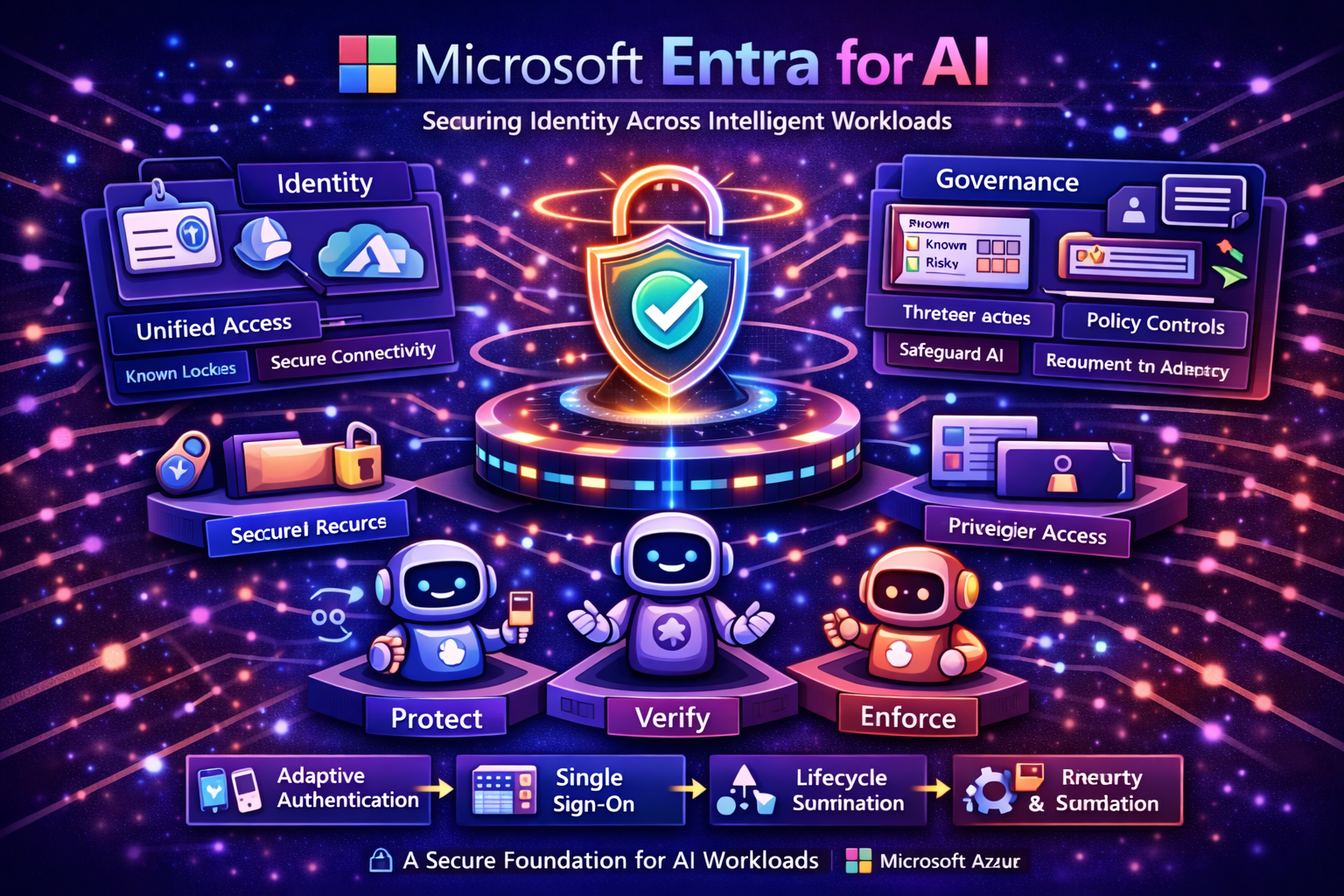
Understanding Microsoft Entra for AI
Microsoft Entra is Microsoft’s identity and network access product family for implementing Zero Trust access controls across users, applications, workloads, and increasingly AI-driven systems. In the context of AI, its role is expanding because intelligent workloads do not operate only through human sign-in. Many AI services run as applications, background services, orchestration layers, pipelines, agents, and connectors that need secure and controlled access to enterprise resources.
Microsoft Entra for AI is therefore not a separate niche product. It is the broader use of Entra identity, access, governance, and policy controls to secure intelligent workloads. This includes foundational identity management through Microsoft Entra ID, workload identities for applications and services, and newer agent identity capabilities designed specifically for AI agents. Together, these capabilities help organizations apply security and governance consistently as AI becomes a larger part of enterprise architecture.
Why Identity Becomes More Important in the Age of AI
AI changes the identity problem because intelligent systems can now retrieve information, invoke APIs, act across workflows, and operate with different levels of autonomy. Traditional access models focused heavily on human users, but modern AI introduces nonhuman actors that also need strong authentication, precise permissions, and policy enforcement. If these intelligent workloads are not secured properly, the organization may face risks related to oversharing, credential leakage, excessive access, and weak accountability.
Microsoft Entra matters in this environment because identity is one of the first security boundaries for AI. Before an agent can retrieve enterprise data, before a model-driven workflow can call an API, and before an automation service can act on behalf of a business process, the identity layer must determine who or what is requesting access and whether that access should be allowed. Entra helps make that decision more secure, more governable, and more aligned with Zero Trust principles.
Core Capabilities of Microsoft Entra for AI
Microsoft Entra includes several capabilities that are highly relevant for intelligent applications, agents, and AI-driven automation.
-Microsoft Entra ID: Provides the foundational identity and access management layer for users, applications, services, and enterprise resources.
-Workload Identities: Secures applications, services, scripts, containers, and AI pipelines that need nonhuman authentication and authorization.
-Managed Identities: Helps Azure-hosted workloads access resources securely without storing or rotating secrets manually.
-Federated Credentials: Enables secure authentication patterns across external systems and platforms without long-lived credentials.
-Conditional Access: Applies Zero Trust access policies to protect resources based on conditions, risk, and contextual requirements.
-Identity Governance: Supports lifecycle management, access reviews, entitlement management, and broader control over who or what has access to resources.
-Agent ID: Introduces identity constructs built specifically for AI agents so they can be governed as first-class identities in Microsoft Entra.
-Monitoring and Auditability: Helps organizations track authentication activity, access behavior, and identity-related events across intelligent workloads.
Microsoft Entra as the Identity Layer for Intelligent Workloads
One of the most important ideas behind Microsoft Entra for AI is that intelligent workloads should not be treated as anonymous or loosely governed processes. They need explicit identities, defined permissions, and auditable behavior. Whether the workload is a retrieval service, a generative AI application, a machine learning pipeline, or an autonomous agent, the identity layer determines how that workload authenticates and what it can reach.
This is strategically important because AI systems often touch sensitive content, business processes, and regulated data. If the identity boundary is weak, every downstream security and governance control becomes harder to trust. Microsoft Entra helps strengthen that boundary so intelligent workloads can participate in enterprise architectures without bypassing foundational access controls.
Workload Identities and Credential-Free Access
Many AI workloads run as services rather than as interactive users. They may ingest data, call APIs, retrieve documents, run background tasks, or orchestrate model-based workflows. These workloads need a secure way to authenticate to enterprise resources, but traditional secrets and embedded credentials create unnecessary risk. Microsoft Entra workload identities address this by giving software workloads identities that can be used to authenticate and authorize access more securely.
This is especially valuable for AI because many intelligent solutions depend on service-to-service communication. Managed identities and federated credentials reduce the operational and security burden associated with storing secrets, rotating credentials, or relying on brittle authentication patterns. As AI architectures grow more distributed, these workload identity capabilities become increasingly important.
Managed Identities and Secure Azure-Native AI Architecture
Managed identities are one of the most practical ways Microsoft Entra supports AI on Azure. When an AI workload is hosted on Azure services, managed identities allow it to authenticate to other Azure resources without developers having to manage credentials directly. This strengthens security while simplifying implementation and operations.
In intelligent application design, this is highly useful because AI solutions often need to access storage, search indexes, databases, key management systems, monitoring services, or downstream APIs. Managed identities make these connections safer and easier to govern, which helps organizations build AI architectures that are both more secure and more maintainable.
Agent ID and the Rise of AI-Native Identity
One of the most significant recent developments in Microsoft Entra is Agent ID, which introduces identity constructs created specifically for AI agents. As organizations deploy more autonomous or semi-autonomous AI systems, traditional models designed for human users or standard service principals can become insufficient for the unique requirements of agents. Agent ID addresses this by giving AI agents first-class identities inside Microsoft Entra.
This matters because agents are not just passive workloads. They can retrieve information, interact with tools, request tokens, and in some cases act autonomously or on behalf of users. By giving them dedicated identity constructs, Microsoft Entra makes it easier to apply security controls, assign permissions, log activity, and manage the lifecycle of agents in a more scalable way.
Agent Identities Versus Workload Identities
Workload identities and agent identities are related, but they are not identical in purpose. Workload identities are designed for software workloads such as applications, services, containers, and scripts that need secure access to resources. Agent identities go further by addressing AI agents as a specific class of nonhuman actor with more dynamic, autonomous, and scalable behavior patterns.
This distinction matters in enterprise AI planning. Some intelligent systems are best modeled as ordinary workloads that need secure service-to-service access. Others behave more like agents that need dedicated identity lifecycle management, broader policy treatment, or delegated and autonomous access patterns. Microsoft Entra gives organizations a clearer way to differentiate those cases and secure them appropriately.
Conditional Access for AI Agents
Zero Trust security becomes more meaningful when access policies apply not only to people, but also to agents. Microsoft Entra extends this approach through Conditional Access for Agent ID, which applies Conditional Access evaluation and enforcement to AI agents. This means agents can be treated as first-class identities subject to security policies in a way that parallels the protection already used for human users and applications.
This capability is important because AI agents can initiate access requests, interact with resources, and participate in workflows that need context-aware security controls. Bringing Conditional Access to agents helps enterprises strengthen security boundaries, reduce uncontrolled access, and align AI operations with the same Zero Trust thinking already used elsewhere in the identity architecture.
Identity Governance for Agents and Intelligent Services
As AI adoption grows, identity governance becomes a larger concern. Organizations need to know which agents exist, who owns them, what access they have, when they should expire, and how they should be reviewed over time. Microsoft Entra helps address this by extending governance concepts such as lifecycle management, access reviews, and entitlement management into AI-related identity scenarios.
This is especially valuable because AI sprawl can become a real governance problem. Without clear ownership and lifecycle control, enterprises risk accumulating orphaned agents, excessive permissions, and weak accountability around intelligent workloads. Strong identity governance helps make AI adoption more sustainable and more compliant over time.
Securing Generative AI Architectures
Enterprise generative AI architectures often include multiple layers, such as client applications, orchestration services, model endpoints, search systems, storage services, and downstream APIs. Each layer may need identity and access controls to ensure the system remains secure from end to end. Microsoft Entra helps enforce authentication, authorization, and governance across these architectural components.
This is important because the security of generative AI systems depends not only on model behavior, but also on whether the surrounding architecture is protected. Strong identity design helps reduce the risk of overprivileged services, uncontrolled tool access, and poorly governed integration paths. In modern AI systems, securing identity is a core part of securing the whole application.
How Microsoft Entra Fits into the Azure AI Ecosystem
Microsoft Entra becomes most valuable when it is used as the identity and access layer across the broader Azure and Microsoft AI ecosystem. It does not replace other security, governance, or AI services. Instead, it helps ensure that those services and workloads interact through trusted identity controls.
Azure OpenAI Service: Benefits from secure identity patterns when applications, orchestration services, and data access layers interact with AI endpoints.
Azure AI Search: Relies on secure access to enterprise knowledge and downstream services in grounded AI architectures.
Microsoft Foundry and Agent Service: Depend on identity and policy controls as agents, tools, and intelligent workflows become more capable and connected.
Azure Machine Learning: Uses workload identities and related controls for secure access across training, deployment, and MLOps environments.
Microsoft 365 Copilot and Copilot Studio: Benefit from identity-aware access boundaries and the newer agent identity model for AI-driven experiences.
Microsoft Entra ID Governance and Global Secure Access: Extend security and governance controls across intelligent workloads, networks, and resources.
Architecture Considerations for Identity in AI Systems
A secure AI architecture requires more than placing a model behind an API. Teams should think carefully about which identities are used at each layer, how workloads authenticate, which permissions are granted, how agents are governed, where Conditional Access applies, and how logs and reviews support operational accountability. These decisions strongly affect the security posture of the entire intelligent system.
In many enterprise architectures, Microsoft Entra serves as the policy and identity backbone. Applications authenticate users, services use workload identities, agents use specialized identities where appropriate, and access to resources is controlled through roles, policies, and governance processes. This layered approach helps keep intelligent workloads aligned with enterprise security expectations as they scale.
Best Practices for Adopting Microsoft Entra for AI
-Start with Identity by Design: Treat identity as a foundational architectural decision for AI workloads rather than a security step added later.
-Use Managed Identities Where Possible: Reduce credential risk by avoiding embedded secrets for Azure-hosted intelligent services.
-Differentiate Workloads and Agents Clearly: Use the right identity model depending on whether the system behaves as a service, an application, or an AI agent.
-Apply Least Privilege Consistently: Grant only the access required for each workload, workflow, or agent to perform its intended task.
-Extend Governance to Nonhuman Identities: Review ownership, lifecycle, and permissions for workloads and agents just as carefully as for user access.
-Use Conditional Access and Zero Trust Controls Thoughtfully: Align AI identity protection with the same principles used for users and applications across the enterprise.
Common Challenges Organizations Should Address
One common challenge is assuming that AI workloads can simply inherit old service account patterns without introducing new risks. In reality, modern intelligent systems often need broader access, more dynamic behavior, and more complex integrations than traditional automation. This means old authentication approaches may no longer be sufficient.
Another challenge is organizational fragmentation. Identity teams, AI builders, data teams, and platform engineers may work independently even though their decisions are closely connected. Microsoft Entra provides the security and identity framework, but successful adoption still depends on aligning architecture, governance, and AI development practices around shared Zero Trust principles.
The Strategic Value of Microsoft Entra for AI
Microsoft Entra delivers strategic value for AI because it helps organizations secure intelligent workloads without slowing innovation unnecessarily. It provides a path to authenticate services securely, govern access more precisely, and extend Zero Trust thinking into new categories of nonhuman actors such as AI agents. This helps enterprises scale AI with more confidence.
For business and security leaders, this means identity becomes one of the key enablers of responsible AI adoption. Strong identity and access controls make it easier to trust intelligent systems, integrate them with enterprise resources, and govern them as they become more capable and more deeply embedded in business operations.
The Future of Identity in Intelligent Systems
The future of enterprise AI will depend heavily on how well organizations secure nonhuman actors. As agents, copilots, automation services, and intelligent workloads become more autonomous and more connected, identity will become even more central to AI architecture. Enterprises will need better ways to distinguish human and nonhuman access, govern agent lifecycles, and enforce Zero Trust policies consistently across these systems.
Microsoft Entra is well positioned for this future because it is already evolving from traditional identity management toward a broader model that includes workload identities and AI-native agent identities. As intelligent workloads become more common, Microsoft Entra is likely to play an increasingly important role in how enterprises secure, govern, and trust AI-driven systems.
Conclusion
Microsoft Entra is securing identity across intelligent workloads by extending authentication, access control, governance, and Zero Trust principles into the growing world of AI services, automation, and agent-driven systems. With capabilities such as workload identities, managed identities, Conditional Access, identity governance, and the newer Agent ID model, it provides a strong foundation for securing modern AI architectures. For organizations building copilots, agents, generative AI applications, and intelligent services on Microsoft Azure, Microsoft Entra is becoming one of the most strategic layers in the enterprise AI security stack.